We use cookies to ensure our site functions properly and to store limited information about your usage. You may give or withdraw consent at any time. To find out more, read our privacy policy and cookie policy.
Manage Cookies
A cookie is information stored on your computer by a website you visit. Cookies often store your settings for a website, such as your preferred language or location. This allows the site to present you with information customized to fit your needs. As per the GDPR law, companies need to get your explicit approval to collect your data. Some of these cookies are ‘strictly necessary’ to provide the basic functions of the website and can not be turned off, while others if present, have the option of being turned off. Learn more about our Privacy and Cookie policies. These can be managed also from our cookie policy page.
Strictly necessary cookies(always on):
Necessary for enabling core functionality. The website cannot function properly without these cookies. This cannot be turned off. e.g. Sign in, Language
Analytics cookies:
Analytical cookies help us to analyse user behaviour, mainly to see if the users are able to find and act on things that they are looking for. They allow us to recognise and count the number of visitors and to see how visitors move around our website when they are using it. Tools used: Google Analytics
No analytics cookies have been enabled on this site. There are no cookies to review.
Share Kingswood Capacity Improvement - Roebank Roundabout on FacebookShare Kingswood Capacity Improvement - Roebank Roundabout on X (formerly Twitter)Share Kingswood Capacity Improvement - Roebank Roundabout on LinkedinEmail Kingswood Capacity Improvement - Roebank Roundabout link
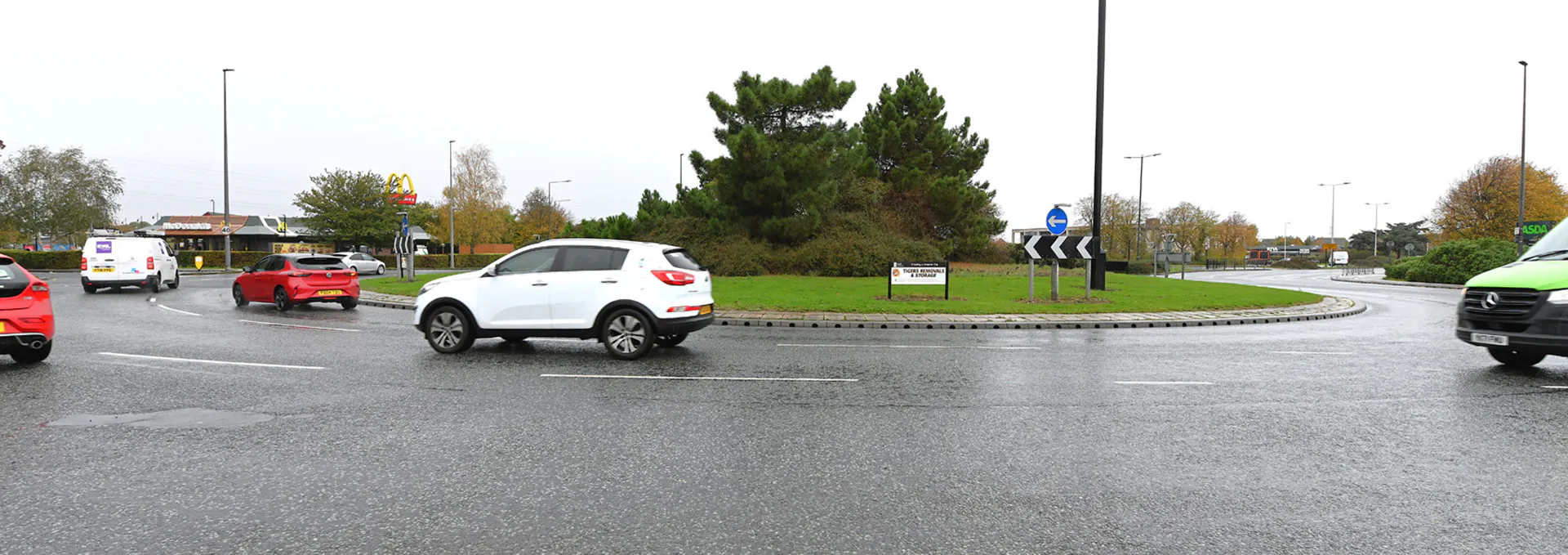
The council has launched a six-week public engagement exercise to get feedback from residents, businesses and commuters on proposals to address a congestion pinch point in the Kingswood area of the city.
Roebank roundabout has been identified as a priority site for improvement as part of a proactive plan by the council to futureproof the network in Hull and prepare the area for an anticipated increase in traffic volumes in the years ahead.
A scheme has been designed to increase capacity at the roundabout, with the aim of reducing congestion and improving journey reliability while also enhancing safety and active travel facilities for pedestrians and people cycling.
The proposals include -
converting the existing roundabout into a signal-controlled roundabout, improving traffic management and enabling more efficient operation of the junction
enhancing walking and cycling infrastructure, including new toucan crossings and segregated off-road cycle routes to provide safer and more accessible connections
improving safety by introducing signal-controlled crossing facilities on all approaches to the junction, allowing pedestrians and cyclists to cross safely where some arms currently have either no crossing provision or unsignalised facilities
widening the carriageway to provide additional traffic lanes and increasing the network capacity, helping to reduce journey times and queuing
selectively removing some trees to facilitate widening works, with replacement planting at a ratio of two new trees for every one tree removed
resurfacing the carriageway and footway to improve their condition, durability and long-term performance